I recently spoke (well, I had a long rambly email chat) with journalist Simone Sheridan from The Cowra Guardian / Canowindra News about the impact of generative AI on voice acting and the wider creative industries.
The resulting article, Looking beyond AI disruption and keeping creativity human in an artificial world, was published on 12 November 2026.
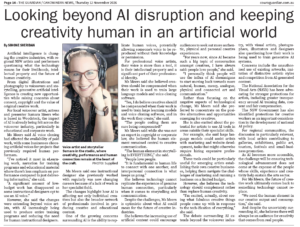
Click image to view article (sorry, subscriber access required).
It’s a subject I’ve been thinking about a great deal, both as a professional voice actor and as someone who works across different areas of the creative industries. (Obviously. I would have to be living under a rock to not be thinking about it.)
What AI means for voice actors
The effects of generative AI are not new. The disruption has been happening for years in the voiceover industry, particularly in corporate narration, eLearning and educational content.
Some businesses are trying to save money by using AI-generated voices for projects that would previously have employed professional voice actors. Ouch.
And it’s not just about whether or not we get hired – the other issue is the non-consensual use of our voices in AI voice cloning applications. In an industry where brand exclusivity and identity is such a huge part of contract negotiations… it’s not good.
I think creative professionals deserve more consideration than these companies – and the law – currently give them when their work contributes to the development of commercial AI products.
However! I remain optimistic, because:
Human connection matters
What I love most about acting and voice acting is that it’s fundamentally about communication and human connection. You cannot beat the feeling of finishing a collaborative and creative day working with other human beings! Nor the high you get when someone really understands the performance you’ve done for them.
Even narrating a medical training module or a corporate video, the goal isn’t simply to deliver words. It’s to help an audience understand something, feel something or connect with a story.
The human element in that process has – will always have! – huge and unquantifiable value.
I told Simone, in amongst my meandering words to her:
The human element in storytelling is EVERYTHING.
People connect with people. We recognise humanity in the things we see, hear, watch, read … and that helps us feel a part of something.
There are opportunities as well as challenges
I’m not opposed to AI as a technology, per se. Some LLM tools make it easier for independent artists and small creative businesses to handle tasks that might otherwise be expensive or time-consuming. And that’s not nothing! Starting a business is hard!
There’s a difference, though, between technology that supports human creativity and technology that replaces it. There actually is no replacement!
As a society, we MUST continue to value and reward the people whose skills, experience and imagination make creative work possible.
Because, call me a weirdo if you want, I believe there will ALWAYS be an audience for creativity that comes from real people.
Simone Sheridan’s article, “Looking beyond AI disruption and keeping creativity human in an artificial world”, was published in The Cowra Guardian / Canowindra News on 12 November 2026. (Subscriber access required.)